

2.0 TDI 140 Elegance DSG
Mercedes E-Class Space, Quality At Near Astra And Focus Prices
***** out of 5
When Ferdinand Piëch, charismatic multi-billionaire autocrat became executive chairman of Volkswagen in 1993, he set out his vision for the company which included strategic competitors for each of its brands: Mercedes and Lexus and their conservative quality for Volkswagen, Alfa Romeo and Lancia for SEAT, BMW and Jaguar for Audiand Volvo and Rover for Skoda.
Pundits and the press scoffed at such apparent arrogance, but now it has all come to pass with perhaps a question mark over SEAT which wobbled away from its high quality, sporty brief in the mid nineties. Subsequently, under ex-Audi purchasing director Schmidt, the brand was put back on track and after Schmidt’s retirement it is now under the competent control of ex-Mazda Europe CEO, Jim Muir who will build on quality improvements, sporty new models and use his sales skills to drive the brand forward.
879,000 people last year didn’t worry about the badge
 The press was particularly cynical about the claims for Skoda, but the Czech brand last year sold, world-wide, nearly twice as many cars as Volvo. I was extolling the virtues of Skoda to an acquaintance recently only to be told that Skoda had still not rid itself of a poor image. Well, 879,000 people last year didn’t seem to have a problem with the image and that figure is against just 170,000 sold in 1991.
Before the scourge of communism, Skoda had a fine engineering heritage going back to the dawn of the motor car. While the Skoda name goes back to 1859 as an arms manufacturer, the founders of the car maker were Laurent and Klement who set up a bicycle repair business in Mladá Boleslav in 1895 and started making cars in 1905. The Skoda Arms company bought out Laurent and Klement in 1924 and over the next 14 years continued to make some of the highest quality cars made anywhere until the occupation by Germany left once proud Skoda as the Hermann Göring Werke serving the German World War II effort.
Volkswagen’s involvement with Skoda started with a joint-venture with the Czech government in 1990, and VW took 100% ownership in 2000.
Skoda design and engineering with Audi engines
While engines might come from Audi and other components from across Volkswagen, much is engineered in-house including body panels and interiors which are unique to Skoda.
 Over the last 11 years, Skoda has launched a series of new models, some of which are predictable like the little Polo–sized Fabia Hatch and Estate and the Golf-sized Octavia Hatch and Estate, while the others like the funky Roomster and Yeti are somewhat unexpected. The large, luxurious Superb ‘limo’ was originally produced as a doctored VW Passat to appeal to Eastern European heads-of-state and government officials but it caught the imagination in the West.
Now having a Mondeo-contender, Skoda decided to market the car to the public at large, with initially very low sales expectations. Such was its success that a more discrete Superb was released in 2006, looking much less like a Passat and offered extras not available on the Volkswagen such as four-wheel drive and a clever twin-boot system, which allowed the rear to open as a traditional boot lid or a full hatch. With this launch, the critics were silenced as Skoda offered Mercedes-Benz E-Class size, space, comfort and quality at near Astra and Focus prices.
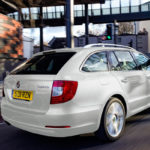
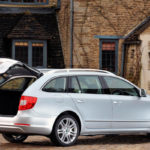
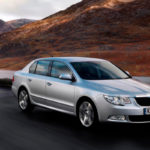
The Superb Saloon is a big car particularly inside and because of its very large window area can look ungainly from some angles. This impression disappears with the Estate which looks as svelte as any luxury load carrier from Audi, BMW or Mercedes. Remove the badges and a focus group would surely think it was from VW’s luxury brand, not the most utilitarian.
There are four Superb trim levels, S, SE, SE Plus and Elegance and even the entry ‘S’ models are well equipped with alloy wheels, all-round electric windows and door mirrors, air conditioning including the glove box, temperature gauge, seven airbags and split-folding rear seats.

The SE adds 17” alloy wheels, rear parking sensors, Alcantara upholstery, cruise control, dual-zone air conditioning, front seat lumbar support, Bolero radio/6-CD changer and SD card slot, leather-trimmed steering wheel and gear lever.
The SE Plus offers multi-function steering wheel, satellite navigation, electrically adjusted driver and front passenger seats, Bluetooth telephone preparation and rear side darkened glass.
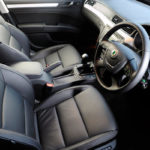
The Elegance has 18” alloy wheels, Bi-Xenon headlights, colour touch-screen ‘satnav’, memory driver’s seat, heated front seats, headlight washers, leather upholstery, and rain sensor.
Prices for all pockets
Prices vary from £17,675 for a Superb 1.4 TSI S Saloon to £32,575 for a Superb Estate 3.6 V6 4×4 Elegance with luxury pack.
Sales in Britain reached 2,500 saloons and 1,960 Estates in 2011.
The Superb is quite big and you feel this when parking and negotiating around town. On the open road, the Superb shrinks around you and offers the highest levels of refinement with an amazing ‘hush’ at high speed. Even on the twisty stuff the car responds very well with excellent steering and turn-in. Thanks to the long wheelbase and carefully set suspension, the ride quality is compliant but the brakes tend to over-sensitivity.
The DSG automated twin clutch gearbox fitted to the test car offers only six speeds unlike the seven on the SEAT Exeo and Volkswagen Passat and eight on the Audi A4, and this is apparent on the road with a less seamless action. It is still a very good gearbox though.

Currently the Superb suffers against the equivalent rival Passat BlueMotion on fuel economy and CO2 emissions; 47.1 mpg and 158 g/km against the Passat’s 54.3 and 135. The biggest effect of this is in company car as the benefit-in-kind tax percentage of the Superb is 24% against the Passat’s 20%. meaning around £35 extra tax each month. Private motorists will pay an extra £50 a year for the road fund licence but this is a small price to pay if you need the considerable extra space.
© Robert Couldwell
January 2012
For publication on Wintons World
| Skoda Superb Estate 2.0 TDI 140 Elegance DSG |
|
|---|---|
| Engine: | 2.0 4-cylinder diesel |
| Power: | 140 PS at 4,200 rpm |
| Torque: | 320 Nm at 1,750-2,500 rpm |
| Gearbox: | 6-speed DSG automatic |
| Drive: | Front-wheels |
| Acceleration: | 0-62 10.3 seconds |
| Top Speed: | 126 mph |
| Fuel Consumption: | 47.6 MPG |
| CO2: | 158 g/km |
| Emissions class: | Euro 5 |
| Length: | 4,848 mm |
| Width: | 2,009 mm inc mirrors |
| Height: | 1,510 mm |
| Weight: | 1,516 kg unladen |
| Wheel-base: | 2,761 mm |
| Suspension: | Front: McPherson struts. Rear multi-link with torsion stabiliser |
| Service Intervals: | 10,000 miles or one year |
| Insurance Group: | 2 years unlimited mileage plus a third year up to 60,000 miles |
| Boot capacity: | 633/1,865 litres |
| Competition: | Ford Mondeo, Vauxhall Insignia, Renault Laguna, SEAT Exeo |
| Rating: | ***** |
| Price: | £26,190 |
| For: | Beautifully built, limousine space, hushed at speed, practical load carrier |
| Against: | Can’t think of anything major |

No comments yet.