
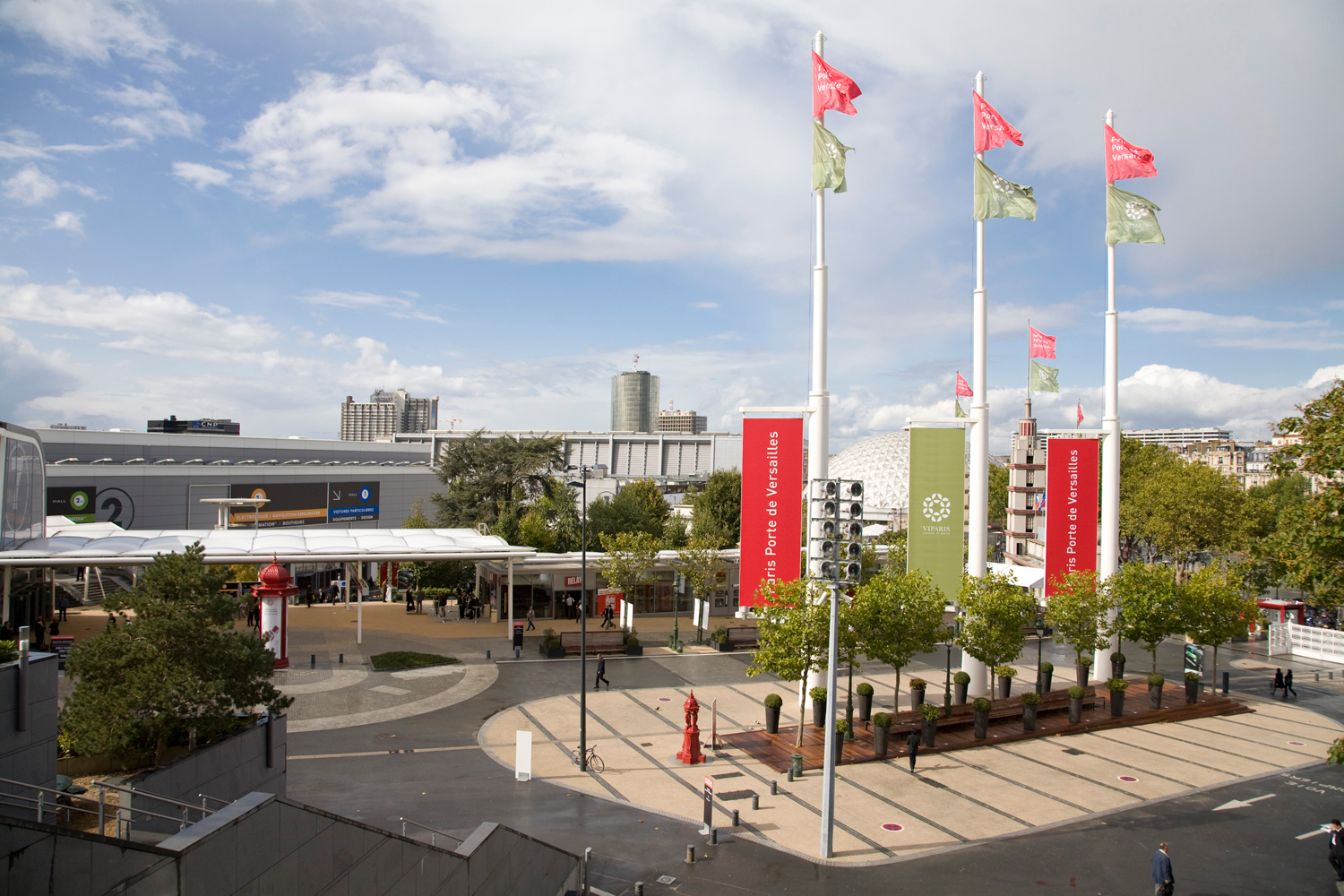
Porte De Versaille
Outlook Cloudy For Europe As Paris Car Show Opens.
“European and global auto sales are close to the peak of the cycle and we see cyclical risks from slowing global growth”
As the European car industry displays its wares at the biennial Paris show, sales prospects look good for the short-term, but the longer haul could be buffeted by Brexit complications, slowing global growth, burgeoning trouble for Volkswagen after dieselgate and worry about new upstart entrants.
The industry is relieved that the predicted economic catastrophe if Britain voted to leave the EU (Brexit) never materialized. Perhaps after a late-night session in the City of Light some top executives will admit to over-cooking the panic scenario. If they hail from Wolfsburg, Germany, they might also concede a worry that the avalanche of law suits threatening the company after dieselgate might become a tsunami.
The industry is facing a tumultuous technology period, particularly in Europe as the developing scandal over the health threat from noxious diesel emissions threatens to torpedo plans to meet harsh carbon dioxide (CO2) emission rules starting in 2021. That will cost money, as will efforts to produce, electric and autonomous cars and internet connected ones too.
And then there’s the nightmare that this move new technology might lead to a brash and rich outsider, from Silicon Valley say, blindsiding the industry with a new product that will isolate and bankrupt them, or using its huge profits to capture strategic players.
Professor David Bailey of the Aston Business School in Birmingham, England, said there was no catastrophic collapse in the U.K. following Brexit, but the consequent devaluation of sterling forced Ford Europe and GM Europe to cut production in Germany because this is a big market for them.
Devaluation means for importers to remain competitive they probably have to cut their prices or profits to retain sales.
Will it hold up?
Bailey wasn’t certain how the European market would hold up.
“We don’t know how European sales will pan out. It’s done better than many expected this year though,” he said.
Industry forecaster IHS Markit predicts good growth for 2016, but hesitates a bit for next year, worrying about the details of Brexit negotiations between Britain and the E.U.
“E.U. car registrations (sales) will grow over 5.5% in 2016 to 14.52 million. In the longer term, there remain too many criteria that are dependent on the outcome of Brexit to give anything more than a range of probable scenarios. For now though, we anticipate that registrations in the E.U. will dip to 14.43 million (in 2017), before seeing growth return in 2018 but only taking it to 14.46 million,” IHS Markit said in a report.
LMC Automotive expects 5.4% growth this year in Western Europe.
“Consumer confidence remains relatively robust in most countries in the region, though U.K. confidence has taken a knock in the last couple of months following the E.U. referendum result,” LMC Auto said in a statement.
And it’s not only worries about Brexit that concern an investment bank like Morgan Stanley.
“European and global auto sales are close to the peak of the cycle, in our view, and we see cyclical risks from slowing global growth. European (economic) growth expectations have clearly fallen in the past few months, and the minimal production growth expected for the second half may prove problematic for suppliers,” said Morgan Stanley analyst Harald Hendrikse in a report.
London-based AlixPartners Managing Director Andrew Bergbaum said the European market is in good health with low interest rates persuading people to buy cars. The U.K. market is likely to get more expensive following the devaluation of sterling after the Brexit vote, but the market generally is doing well.
Brexit worries
“We see Western Europe continuing to grow – albeit slowly. Brexit worried everybody but the we haven’t seen any noticeable impact yet. The depreciation of sterling is likely to affect the car industry – the majority of cars we buy are imported and they could get more expensive,” Bergbaum said.
Western Europe includes all the big markets like Germany, Britain, France, Italy and Spain. The E.U. includes various small eastern European countries as well.
At the show, which alternates every year with Frankfurt, Germany as the main car event in the fall, the industry will be looking at new ways to make money, offered by so-called mobility services. All the big manufacturers are looking into this as traditional car ownership patterns change.
Ford recently said its mobility services – for instance car sharing, car clubs, short-term rental – would eventually generate 20% profit margins. That’s way more than car makers usually generate, and explains why new entrants are sniffing around trying to grab the business.
“New players like Google, UBER, and Alibaba are trying to get their feet into the auto arena,” said Professor Stefan Bratzel, from the Center of Automotive Management in Bergisch Gladbach, Germany.
The Paris Car Show, Mondial de l’Automobile, is open through October 16 at Paris Expo, Porte de Versailles.

No comments yet.