
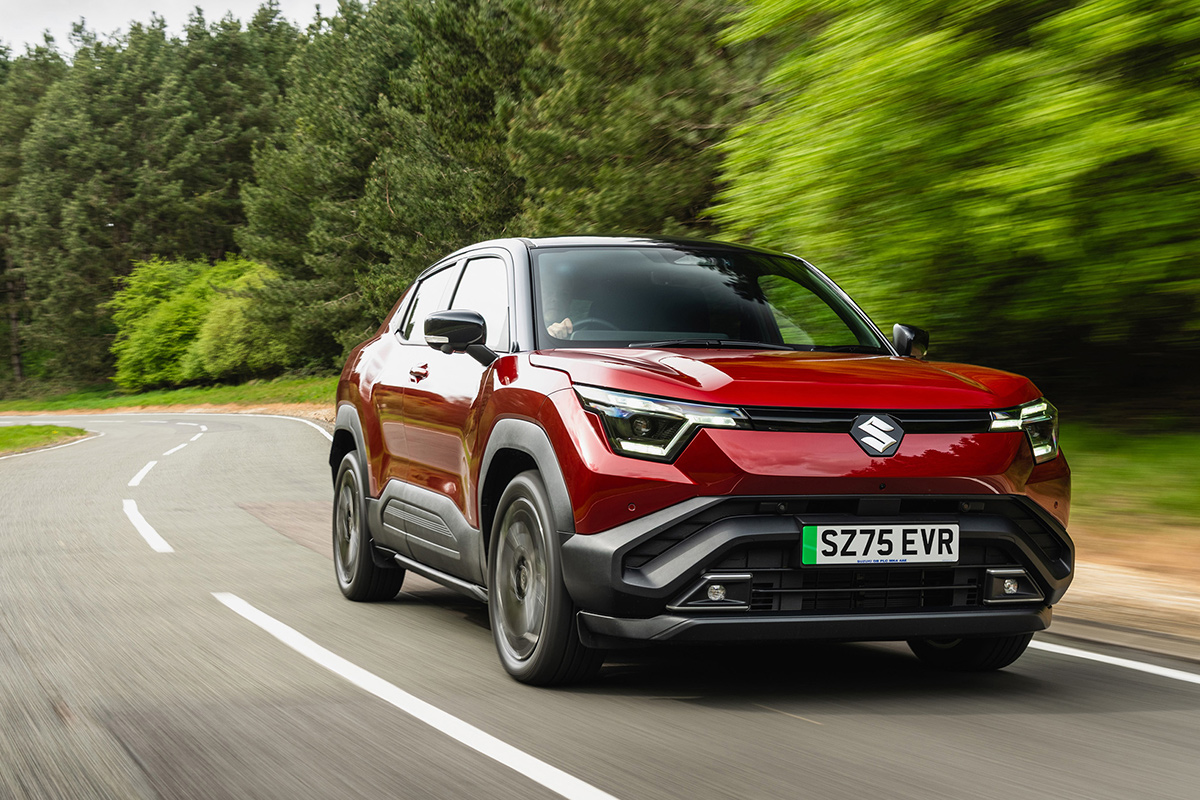
Suzuki eVitara
Suzuki’s European EV Strategy Boosted By eVitara, And Toyota.
Suzuki of Japan is racing to become electrified in Europe and it will be propelled down this path with help from its affiliate Toyota and its new eVitara.
Some analysts say Suzuki will struggle to meet government electrification targets, but others reckon the affiliation with Toyota will prove the key to success. European Union plans to stimulate small cars will play to Suzuki’s core strengths in the manufacture of so-called “kei” cars.
Britain, one of its biggest markets in Europe, has brought forward its date for outlawing the sale of internal combustion engine-powered vehicles to 2030. Hybrid sales can continue until 2035.
Most European markets have signed up to a less onerous 2035 deadline for new ICE sedans and SUV sales. And this less harsh regime is currently under pressure to be substantially liberalized, with an extension likely for hybrids and plug-in hybrids and perhaps allowing eFuels too, past 2035.
Suzuki has come late to electric vehicles and is arguably among the weakest mainstream carmakers but is now launching its first EV, the eVitara, the result of a joint venture with Toyota.
Urban Cruisers for Toyota
Toyota has a 4.9% stake in Suzuki, and the eVitara, a compact SUV, is produced in India. Toyota’s share of Suzuki’s production is called the Urban Cruiser.
Over the last 10 years, Suzuki has stayed a niche brand in Europe, with sales hovering between 1.2% and 1.6%. Latest data from the European Automobile Manufacturers Association (ACEA) showed Suzuki sales down 16% in the first 10 months of this year to 147,000 from 175,000 in the same period last year. That’s a market share of 1.3%. The ACEA league table puts Suzuki one place behind Tesla’s 181,000 and just above BYD’s 138,400 and Mazda’s 127,400.
Suzuki’s sales in Europe have been buoyed by strong sales of its Vitara and S-Cross compact SUVs, and the popular and cute little Swift.
Suzuki has tried to make up for the disadvantages of its small size by seeking alliances. In 2010 Suzuki had a brief fling with Volkswagen. VW purchased a 19.9% stake, but there were severe frictions right from the start, said to be a combination of major cultural clashes and mutual accusations of contract breaches. The core of the issue was a fundamental disagreement over the nature of their partnership and a lack of trust, and the combination was formally terminated after a couple of years.
Suzuki pulled out of the U.S. market in 2012, although it continued selling motorcycles, ATVs, and marine products.
Suzuki has had more success with its deal with Toyota, which took its just under 5% stake in 2019. Toyota provided Suzuki rebadged models of its own, like the RAV4-based Suzuki Across. Suzuki’s success in a Britain. with new ICE models banned by 2030, will hinge on Toyota technology and joint product programs.
Long-term sales slide
This EV problem is beginning to show up in a long-term slide in sales.
According to Germany’s Dataforce, Suzuki’s European sales fell sharply in October, and have been pointing downwards since 2019. Sales in Britain are down almost 50% since 2019. Dataforce senior automotive analyst Benjamin Kibies said most Japanese brands in Europe are under pressure, and suffer most from Chinese sales and a lack of EVs.
Suzuki has many qualities, but pressure is mounting.
“The Suzuki brand enjoys a highly loyal core customer base that values exceptional reliability and longevity. However, maintaining this loyalty requires a robust local dealer network. With current sales volumes, this network is coming under increasing pressure, raising the risk of a downward spiral,” Kibies said.
“Regarding electrification, Suzuki can source core components from suppliers like BYD and other players—as demonstrated with the e-Vitara—as long as in-house development remains economically unfeasible. For customers seeking an affordable and dependable vehicle, this strategy delivers more than adequate results,” he said.
Jamel Taganza, vice-president of French auto consultancy Inovev said sales of the eVitara are slowly gaining momentum, but have to contend with some impressive competitors.
“Across the first 10 months of this year, only around 500 eVitaras were sold in Europe. The segment is already highly competitive, with strong performers such as the Kia EV3 (53,000), Volvo EX30 (34,000), Hyundai Inster (26,000), and Hyundai Kona (24,000). Given this context, we forecast annual volumes of fewer than 10,000 units in both 2026 and 2027—potentially with a significant share going to professional buyers, such as company-car fleets,” Taganza said.
Suzuki U.K. said production of this model in India only commenced in September 2025 with the U.K. as the first market to launch the car just six weeks ago. It has also recently launched in one or two other markets including Denmark and Norway.
Small car lifeline for Suzuki
The European Union has said it wants to stimulate local production of small cars, and this is an area which may provide a lifeline for Suzuki.
“At present, the brand’s lineup in Europe lacks dynamism and differentiation, with a relatively narrow range and several models derived from Toyota. However, if Europe eventually creates a regulatory and market space for a “Kei car” segment—where Suzuki is a long-standing specialist—they could regain momentum. This would give Suzuki an opportunity to rebuild volume and potentially return to a stronger position by 2030,” Taganza said.
Kei cars were created in post-WWII Japan to encourage mobility and are well-suited for narrow roads and limited parking in cities. They are typically the most affordable and fuel-efficient vehicles in Japan, accounting for a significant portion of new car sales. Kei cars, or keijidōsha, are a special, tax-advantaged class of small cars made to to strict limits on dimensions and engine power.
British automotive analyst Charles Tennant agrees Suzuki is coming late to the EV market but won’t have much trouble meeting European rules.
Tennant said Suzuki is only the fourth biggest Japanese car manufacturer after Toyota, Nissan, and Honda but is still a major player on the global stage with annual production of around 3.3 million cars per year with two thirds of that production occurring in India, which is also its largest market accounting for more than half its sales.
Small niche brand
“Suzuki is renowned for producing compact, fuel-efficient cars such as the Swift, Vitara and the iconic rugged Jimny; as well as having a long history of developing all-wheel-drive systems. Although Suzuki has been seen as a relative late comer in vehicle electrification it has been collaborating with Toyota for almost a decade, sharing Toyota’s expertise in hybrid and electric vehicle technology combined with Suzuki’s strength in compact affordable cars, along with mutual supply of vehicles and components especially in India and Europe,” Tennant said in an email exchange.
“Suzuki is a small niche brand in Europe and the U.K. with no more than 14% of global sales in Europe and less than 30,000 sales per year in the U.K. from around 100 dealerships, so the impending ban on sales of new internal combustion engine cars from 2030 and hybrids from 2035 is not likely to be causing any headaches at head office, especially now that they are on the path to electrification now anyway.”

Suzuki eVitara
Suzuki eVitara Ultra Allgrip
Electric motor: 183 hp – 174 front/65 rear
Torque: 307 Nm
Battery: 61 kWh lithium iron-phosphate (LFP)
Claimed range: 245 miles (WLTP)
Drive: all wheels
Acceleration: 0-60 mph 7.1 seconds
Top Speed: 93 mph/150 km/h
Price: £37,799 after tax ($50,400)

No comments yet.