
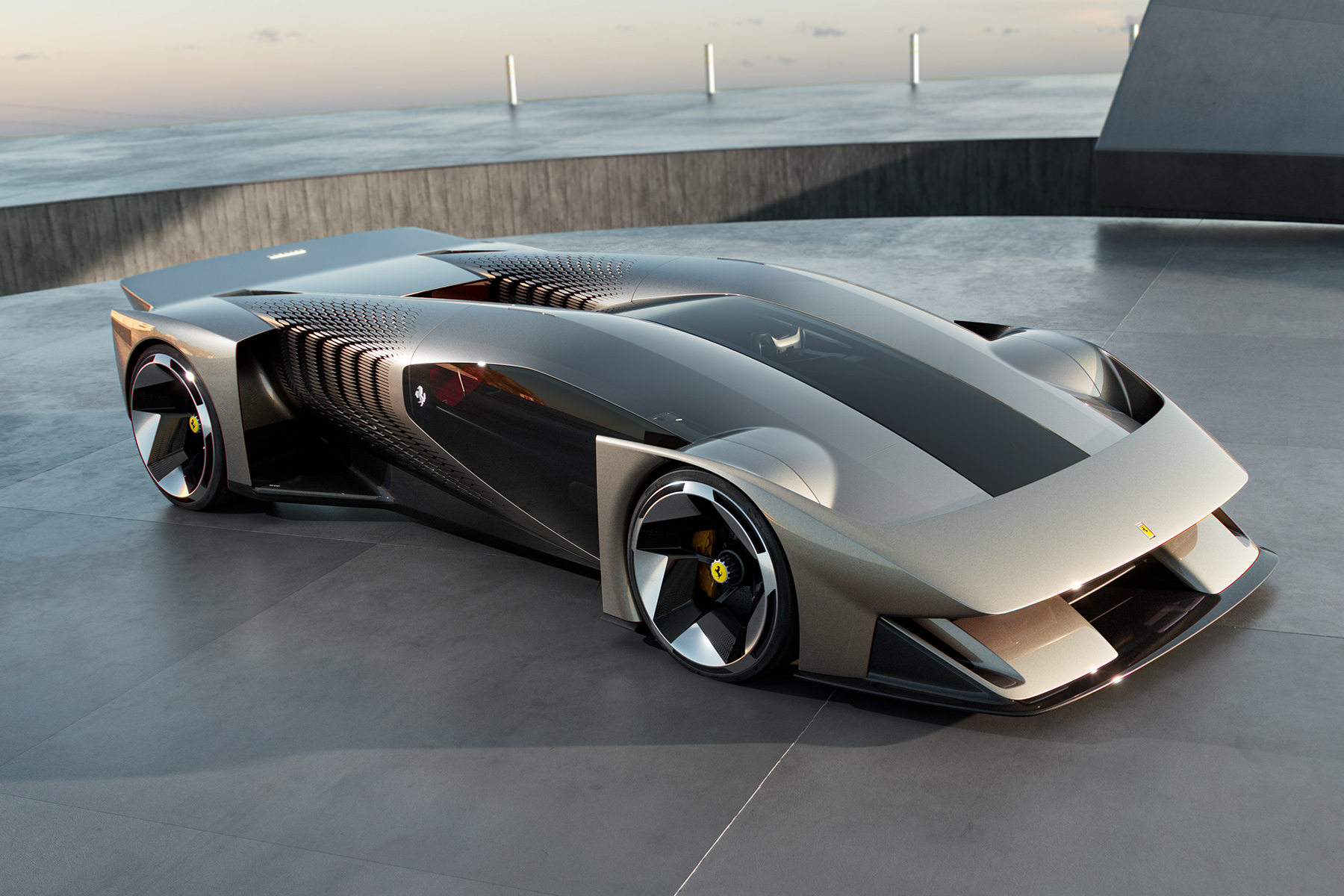
Ferrari F76
Ferrari Shares Rally, But Will Silent EV Spook Sales?
“Ferrari’s ability to allocate key models and thus control revenue and margins based off its long coverage of its order book, now approaching 2 years, had long been seen as its superpower, driving its valuation towards that of luxury sector pinnacle, Hermès”.
Ferrari shares have rallied from the depths as investors welcomed the company’s latest results and forecasts, but that shows bravery given its next new sports car is likely to cost almost $600,000 and be completely silent.
Ferrari owners are used to announcing their arrival with the raucous scream of a V12 combustion engine, but its first electric car, to be called the Luce, could present big challenges for the sales force.
Meanwhile, the shares have recovered all of the recent slide, zooming more than 15% in a couple of days to close at €323.60 Friday up from the low of €280.
Ferrari shares have lost almost a third of their value since last October, when it provided profit estimates which investors interpreted as a signal the long-established era of super profits might be ending. Investors had become used to the company providing conservative estimates which it easily exceeded. In October, the level of modesty was overdone and investors became nervous.
Ferrari announced on February 10 profits (adjusted earnings before interest, tax, depreciation and amortization EBITDA) rose 9% to €700 million ($830 million) in the fourth quarter, compared with the same period last year, and forecasts of around €668 million ($790 million).
Ferrari forecast core adjusted EBITDA of more than €2.93 billion ($3.5 billion) in 2026 compared with €2.77 billion ($3.3 billion) in 2025.
“Demand is solid and managed with discipline”
“Demand for Ferrari remains very solid and is managed with discipline in every market reflecting our exclusivity model,” CEO Benedetto Vigna said in a statement.
Vigna said Ferrari’s order book extends towards the end of 2027 and said the €240,000 ($284,000) Amalfi and the €460,000 ($545,000) 849 Testarossa were heading the list. Sales last year slipped 112 to 13,640. Ferrari will launch five new models this year, including the electric Luce in May.
Berenberg Bank said the results and new guidance offered investors positive momentum.
“We view this as a small step in the right direction towards rebuilding confidence in the long Ferrari thesis and believe this may mark the return to the beat-and-raise cadence that many have come to expect from Ferrari and should build further confidence that the company can exceed its targets laid out at the capital markets day last October,” the bank said in a report.
The bank described management’s tone at a meeting for analysts after the results announcement as “confident”.
High conviction
“We view the overall tone on the conference call as refreshingly confident, with management conveying high conviction on achieving its 2026 targets despite significant model changeover and FX headwinds, highlighting that F80 contributions will more than offset the planned ramp-down of the 499P Modificata and SF90 XX families, and price/mix offsetting some elevated costs,” it said.
Berenberg Bank rates Ferrari shares as a “Buy”.
Investment researcher Bernstein said Ferrari’s new 2026 guide for EBIT margin of 29.5% significantly exceeded bearish market whispers. Bernstein, in a report headed “Ferrari: A large measure of reassurance”, said the company had re-asserted the Ferrari superpower.
“Ferrari’s ability to allocate key models and thus control revenue and margins based off its long coverage of its order book, now approaching 2 years, had long been seen as its superpower, driving its valuation towards that of luxury sector pinnacle, Hermès. That convergence was undermined by Ferrari’s 2026-30 plan guidance provided on 9 October 2025,” Bernstein said.
“The new 2026 guidance and management’s constructive comments on 10 February provide further kindling to feed the equity story. Ferrari must continue to fan that flame, assuring the market that its growth algorithm remains intact,” the report said.
Bernstein rates Ferrari “Outperform”.
Who wants a silent Ferrari?
Not everybody is convinced of Ferrari’s “superpower” or that the new EV will be a big success.
“Times remain challenging for all Western car manufacturers, perhaps somewhat less so for super-luxury manufacturers. However, every boom eventually comes to an end,” said Frank Schwope, automotive industry lecturer at the University of Applied Sciences FHM Berlin.
The market for luxury goods seems to thrive even through the roughest economic waters, but some wonder if it finally could be running out of road.
Ferrari is entering uncharted waters with its first all-electric launch later this year. Investor might be worried about the launch of the Luce, the first silent Ferrari, said by Reuters to cost at least €500,000 ($590,000).
Schwope has his doubts.
Porsche experience an EV warning
“Engine noise and engine technologies are important features for Ferrari. A switch to electric motors, which are much simpler in terms of technology, could jeopardize its success and cause margins to collapse. Porsche has already experienced this with its electric strategy,” Schwope said in an email exchange.
Investment researcher Jefferies felt Ferrari’s position had been improved by the latest developments, but wasn’t entirely convinced.
“Investors’ enthusiastic reaction to a more assured than feared 2026 guidance is understandable given the scale of the derating since October last year. Whether this will put to bed concerns of more labored price elasticity at the volume end of the product range is less clear,” Jefferies said.
Jefferies rates Ferrari as a “Hold”.
Investors will be wondering just how potential buyers will react to its first EV. Ferrari has shown it can sell SUVs and hybrids so the omens are good. And Ferrari will only need to convince between 1,000 and 2,000 of the super-rich to make the project viable, according to analysts.
If it works, the brand becomes future proofed. The EU has already diluted its CO2 rules to allow supercars to be powered by combustion engines after 2035.

No comments yet.